
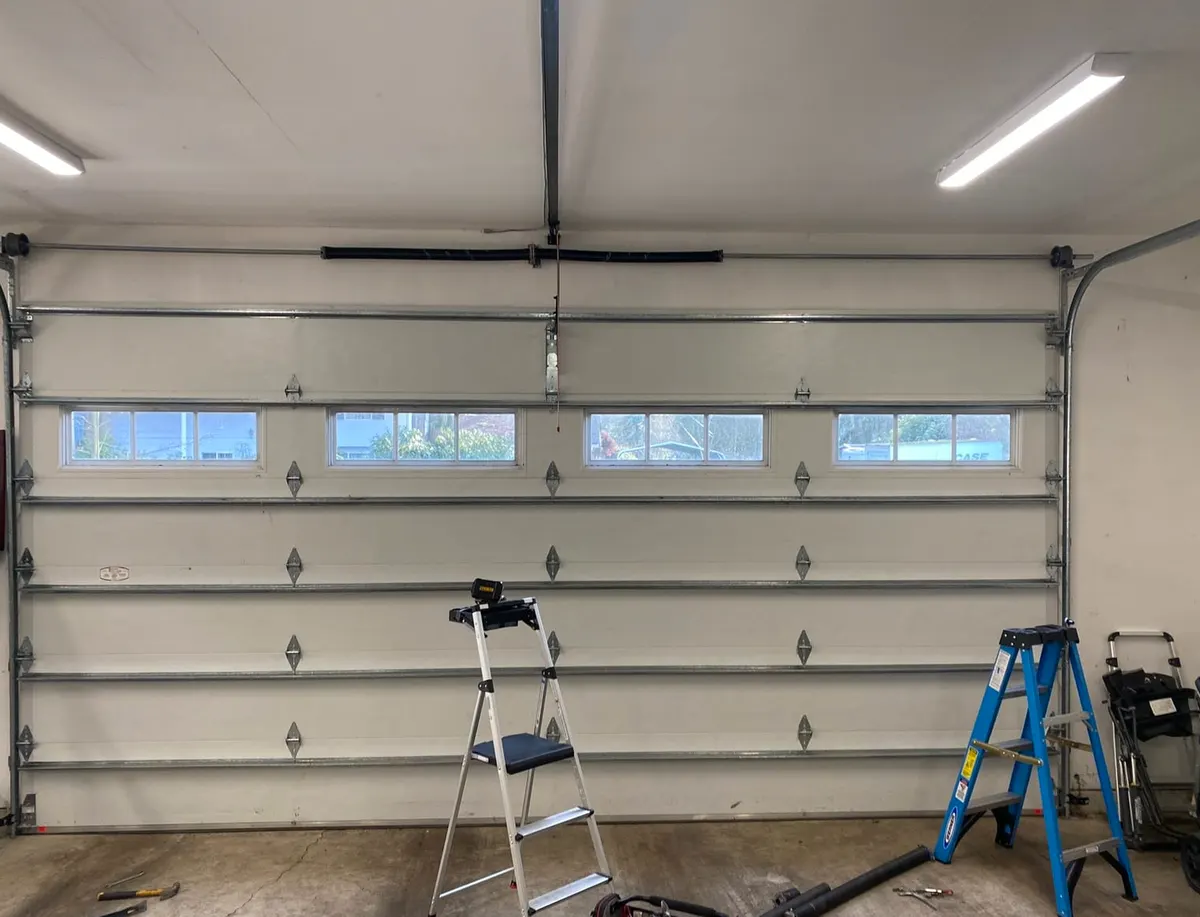
Pull the release cord, lift the door halfway by hand, and let go. If it stays roughly where you left it, your door is balanced. If it crashes down or launches upward, your springs are no longer doing their job — and your opener has been quietly picking up the slack, probably for months.
That matters more than it sounds like. An opener is built to move a balanced door. It is not built to lift the full dead weight of a 150-to-200-pound door on its own, day after day. When it's forced to, something in that drivetrain is working overtime, and it won't last.
What an Unbalanced Door Does to Your Opener
Garage door springs — torsion or extension — are supposed to carry almost all of the door's weight. The opener's motor is only meant to provide the final push to start and stop the motion. When a spring weakens or loses tension, the opener has to make up the difference every single time the door runs.
Over weeks and months, that shows up as:
- A motor that runs hotter and louder than it used to
- Faster wear on the drive gear, a common and avoidable failure point
- A chain or belt that stretches or skips more often
- The door reversing unexpectedly mid-cycle as the opener's force sensors trip
- A capacitor or circuit board that fails sooner than it should, since the motor is drawing more power than it was designed for
In other words, a spring problem that costs relatively little to fix can turn into an opener replacement if it's ignored long enough. The seasonal temperature swings here don't help — steel springs lose a bit of tension as they contract in cold weather, so a door that was balanced in August can be noticeably off by the time winter sets in.
How to Test Garage Door Balance
Tools Needed
- None required, but work gloves and a flashlight make it easier
- A step stool if you want a closer look at the springs once the door is open
Steps
- Close the door completely. You need a full range of motion to test it properly.
- Locate the manual release cord — the red-handled rope hanging from the trolley on the opener's rail — and pull it. This disconnects the door from the opener so you're testing the door and springs alone.
- Lift the door by hand to about waist height (3 to 4 feet). Pay attention to how heavy it feels going up. It should move smoothly, without sudden heaviness or looseness.
- Let go and watch. A balanced door will stay in place or drift down only slightly. An unbalanced door will either drop quickly or shoot upward on its own.
- Repeat at a second position — closer to fully open — since some doors are balanced at one height and not another, which points to uneven spring wear.
- Reconnect the opener by pulling the release handle again (or running the door through a cycle until the trolley re-engages) before using the automatic opener again.
If the door failed either test, don't leave it running on the opener in that condition, even temporarily. Every cycle is extra wear on parts that are already compensating for something they shouldn't have to.
What a Homeowner Can Handle vs. What Needs a Technician
Safe for a homeowner:
- Running the balance test itself
- Visually inspecting springs for gaps, rust, or stretching
- Checking that hinges, rollers, and track brackets are tight
- Lubricating rollers and hinges with a garage-door-specific lubricant (not WD-40, which washes out grease rather than replacing it)
Needs a technician, no exceptions:
- Adjusting spring tension or replacing a torsion or extension spring — these are under extreme load and have caused serious injuries to homeowners who've tried this themselves
- Realigning or replacing cables, pulleys, or drums connected to the spring system
- Diagnosing why one side of the door is heavier than the other, which often means uneven spring wear or a bent track
When to Call Cuyahoga Falls Garage Door Pro
If your door failed the balance test, give us a call before you run it on the opener again. We'll check spring tension, cable condition, and track alignment, and handle spring replacement safely with the right tools and tensioning equipment. If the opener's already showing signs of strain — grinding, slow response, random reversals — we'll inspect it as part of the same visit and recommend repair or replacement based on what we find. Routine garage door maintenance before winter is also the easiest way to catch a balance problem before the cold makes it worse.
If you're in Cuyahoga Falls, Akron, Stow, Tallmadge, Hudson, Munroe Falls, Silver Lake, or Northampton and your door isn't passing this test, reach out to Cuyahoga Falls Garage Door Pro today — we'll get it balanced and your opener out of overtime.